
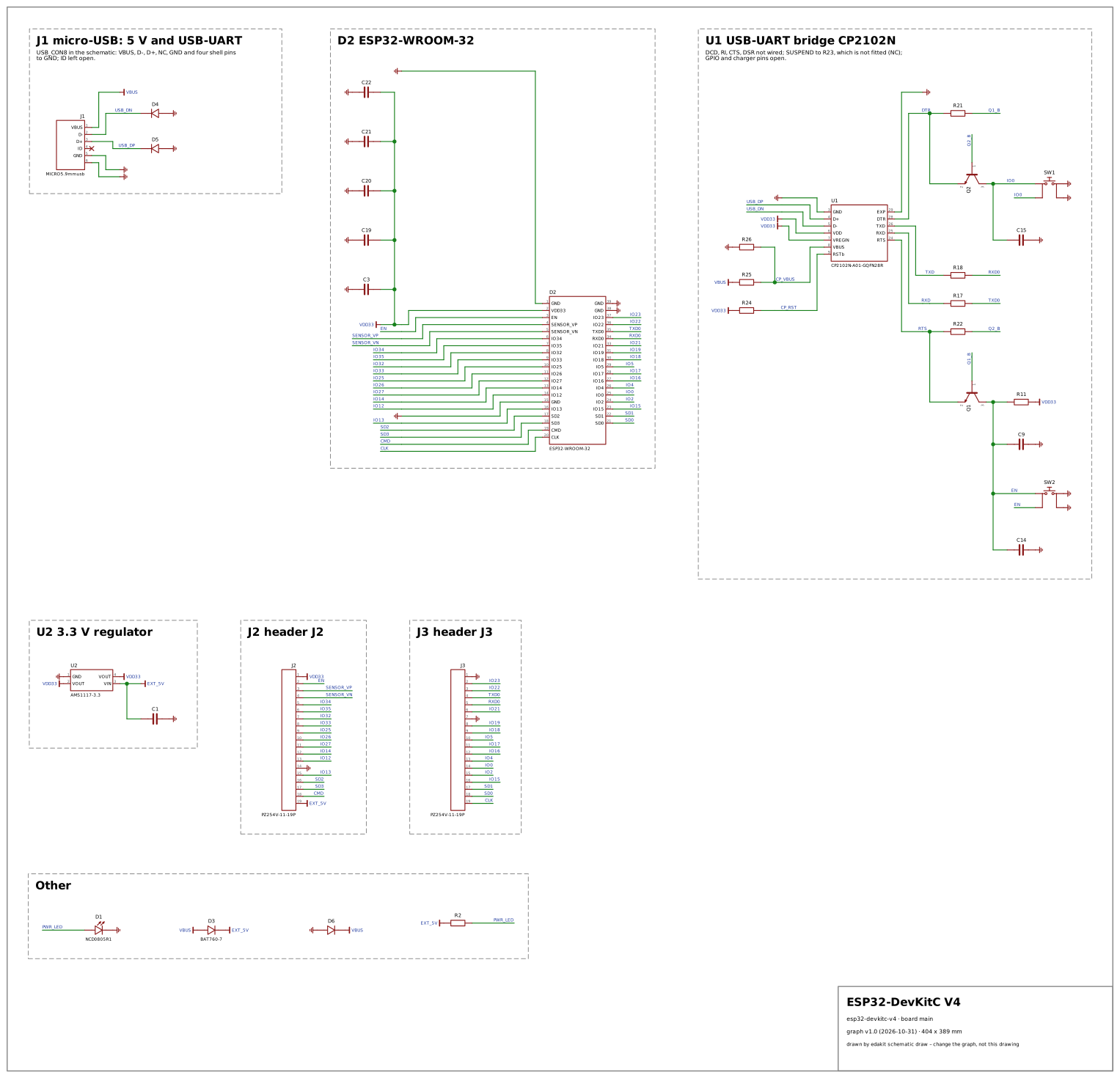
Why: the board many ESP32 projects start from: usb, radio and power on one board – the USB-UART bridge, the two transistors of the auto-program circuit, the 3.3 V regulator, the module's bands and e.i.r.p. The domain radio has no reference circuit; this design was the first to stand in for it.
| Stage | Code | Where | Judged | Why |
|---|---|---|---|---|
| check | DOCS.file | edakit.toml | criterion | The transcription has no requirements file: what the published design must do stands in its own documents, not in edakit's form. edakit requires the file before a release (handbook 3.6); it is no point of the design. |
| check | LIM.v | D6 | real | The LESD5D5.0's working voltage (VRWM 5.0 V) is below USB's 5.25 V. It breaks down at 5.6 V at the earliest, so it leaks more than its datasheet promises; it does not clamp. |
| check | LVL.undefined | SENSOR_VP | real | Input-only pin without a pull resistor (GPIO34–39 have none) that only goes to the header: it floats until the user's circuit drives it – intended for a development board. |
| check | LVL.undefined | SENSOR_VN | real | Input-only pin (GPIO39) without a pull resistor, only on the header: it floats until the user's circuit drives it – intended. |
| check | LVL.undefined | IO34 | real | Input-only pin (GPIO34) without a pull resistor, only on the header: it floats until the user's circuit drives it – intended. |
| check | LVL.undefined | IO35 | real | Input-only pin (GPIO35) without a pull resistor, only on the header: it floats until the user's circuit drives it – intended. |
| check | LIM.band/firmware | D2 | real | The module's 2412–2484 MHz reach channel 14 (Japan); in the EU the firmware keeps to channels 1–13 – the firmware's point, not the board's. |
| check | LIM.eirp/unknown | D2 | lacks | The module datasheet states neither its PCB antenna's gain nor the Bluetooth bands. |
| check | REQ.value/pin | D2.3 (EN) | real | Espressif's own module datasheet recommends 10 kΩ / 1 µF at EN; the DevKitC V4 has 100 nF (with SW2's 100 nF, 200 nF) – the short reset delay behind its known boot problems. |
| check | REQ.value/pin | U1.9 (RSTb) | real | The CP2102N datasheet recommends a 1 kΩ pull-up on RSTb; the DevKitC fits 2 kΩ – minor. |
| check | STRUCT.prefix | D2 | real | The schematic calls the module D2 – a naming point. |
| check | PARTS.fact/reach | C105167 | lacks | A board that is sold names the SVHCs above 0.1 % (REACH Art. 33); the transcription took no supplier REACH statement for this part. |
| check | PARTS.fact/reach | C124187 | lacks | A board that is sold names the SVHCs above 0.1 % (REACH Art. 33); the transcription took no supplier REACH statement for this part. |
| check | PARTS.fact/reach | C140692 | lacks | A board that is sold names the SVHCs above 0.1 % (REACH Art. 33); the transcription took no supplier REACH statement for this part. |
| check | PARTS.fact/reach | C17414 | lacks | A board that is sold names the SVHCs above 0.1 % (REACH Art. 33); the transcription took no supplier REACH statement for this part. |
| check | PARTS.fact/reach | C17477 | lacks | A board that is sold names the SVHCs above 0.1 % (REACH Art. 33); the transcription took no supplier REACH statement for this part. |
| check | PARTS.fact/reach | C17552 | lacks | A board that is sold names the SVHCs above 0.1 % (REACH Art. 33); the transcription took no supplier REACH statement for this part. |
| check | PARTS.fact/reach | C17604 | lacks | A board that is sold names the SVHCs above 0.1 % (REACH Art. 33); the transcription took no supplier REACH statement for this part. |
| check | PARTS.fact/reach | C2150 | lacks | A board that is sold names the SVHCs above 0.1 % (REACH Art. 33); the transcription took no supplier REACH statement for this part. |
| check | PARTS.fact/reach | C22465879 | lacks | A board that is sold names the SVHCs above 0.1 % (REACH Art. 33); the transcription took no supplier REACH statement for this part. |
| check | PARTS.fact/reach | C26011 | lacks | A board that is sold names the SVHCs above 0.1 % (REACH Art. 33); the transcription took no supplier REACH statement for this part. |
| check | PARTS.fact/reach | C29277 | lacks | A board that is sold names the SVHCs above 0.1 % (REACH Art. 33); the transcription took no supplier REACH statement for this part. |
| check | PARTS.fact/reach | C318884 | lacks | A board that is sold names the SVHCs above 0.1 % (REACH Art. 33); the transcription took no supplier REACH statement for this part. |
| check | PARTS.fact/reach | C393940 | lacks | A board that is sold names the SVHCs above 0.1 % (REACH Art. 33); the transcription took no supplier REACH statement for this part. |
| check | PARTS.fact/reach | C49678 | lacks | A board that is sold names the SVHCs above 0.1 % (REACH Art. 33); the transcription took no supplier REACH statement for this part. |
| check | PARTS.fact/reach | C503587 | lacks | A board that is sold names the SVHCs above 0.1 % (REACH Art. 33); the transcription took no supplier REACH statement for this part. |
| check | PARTS.fact/reach | C5274290 | lacks | A board that is sold names the SVHCs above 0.1 % (REACH Art. 33); the transcription took no supplier REACH statement for this part. |
| check | PARTS.fact/reach | C6186 | lacks | A board that is sold names the SVHCs above 0.1 % (REACH Art. 33); the transcription took no supplier REACH statement for this part. |
| check | PARTS.fact/reach | C84256 | lacks | A board that is sold names the SVHCs above 0.1 % (REACH Art. 33); the transcription took no supplier REACH statement for this part. |
| check | PARTS.fact/rohs | C105167 | lacks | A board that is sold states the RoHS status of every part it lists (RoHS 2011/65/EU); the transcription took none for this part. |
| check | PARTS.fact/rohs | C124187 | lacks | A board that is sold states the RoHS status of every part it lists (RoHS 2011/65/EU); the transcription took none for this part. |
| check | PARTS.fact/rohs | C140692 | lacks | A board that is sold states the RoHS status of every part it lists (RoHS 2011/65/EU); the transcription took none for this part. |
| check | PARTS.fact/rohs | C17414 | lacks | A board that is sold states the RoHS status of every part it lists (RoHS 2011/65/EU); the transcription took none for this part. |
| check | PARTS.fact/rohs | C17477 | lacks | A board that is sold states the RoHS status of every part it lists (RoHS 2011/65/EU); the transcription took none for this part. |
| check | PARTS.fact/rohs | C17552 | lacks | A board that is sold states the RoHS status of every part it lists (RoHS 2011/65/EU); the transcription took none for this part. |
| check | PARTS.fact/rohs | C17604 | lacks | A board that is sold states the RoHS status of every part it lists (RoHS 2011/65/EU); the transcription took none for this part. |
| check | PARTS.fact/rohs | C2150 | lacks | A board that is sold states the RoHS status of every part it lists (RoHS 2011/65/EU); the transcription took none for this part. |
| check | PARTS.fact/rohs | C26011 | lacks | A board that is sold states the RoHS status of every part it lists (RoHS 2011/65/EU); the transcription took none for this part. |
| check | PARTS.fact/rohs | C29277 | lacks | A board that is sold states the RoHS status of every part it lists (RoHS 2011/65/EU); the transcription took none for this part. |
| check | PARTS.fact/rohs | C318884 | lacks | A board that is sold states the RoHS status of every part it lists (RoHS 2011/65/EU); the transcription took none for this part. |
| check | PARTS.fact/rohs | C393940 | lacks | A board that is sold states the RoHS status of every part it lists (RoHS 2011/65/EU); the transcription took none for this part. |
| check | PARTS.fact/rohs | C49678 | lacks | A board that is sold states the RoHS status of every part it lists (RoHS 2011/65/EU); the transcription took none for this part. |
| check | PARTS.fact/rohs | C503587 | lacks | A board that is sold states the RoHS status of every part it lists (RoHS 2011/65/EU); the transcription took none for this part. |
| check | PARTS.fact/rohs | C5274290 | lacks | A board that is sold states the RoHS status of every part it lists (RoHS 2011/65/EU); the transcription took none for this part. |
| check | PARTS.fact/rohs | C6186 | lacks | A board that is sold states the RoHS status of every part it lists (RoHS 2011/65/EU); the transcription took none for this part. |
| check | PARTS.fact/rohs | C84256 | lacks | A board that is sold states the RoHS status of every part it lists (RoHS 2011/65/EU); the transcription took none for this part. |
| sim | LIM.i | J1 | real | With the module at the 0.5 A its datasheet asks the supply for, the board draws 526 mA from a USB 2.0 port that gives 500 mA. |
| sim | LIM.t | D3 | real | The BAT760 dissipates 0.22 W at 0.5 A; at 500 K/W (its datasheet's minimum pad) its junction reaches 137 °C at 25 °C ambient. |
| sim | SIM.state | U2 | real | At 4.75 V, after the cable and the Schottky, the AMS1117 (1.1 V dropout) gives 3.07 V, below 3.3 V ± 3 % – still above the module's 3.0 V. |
| sim | SIM.state | D1 | criterion | The power LED gets 0.96 mA at the lowest supply and the highest VF, below edakit's 1 mA for an LED that is on; the design's own aim for it is not known. |
- A TVS held to its working voltage with a rectifier's margin of 1.5 (LIM.v on D4, D5, D6) – values tvs.
- The AMS1117's VOUT on pin 2 and on its tab counted as two drivers (LVL.contention on VDD33).
- The CP2102N's RXD with its weak pull-up taken as floating (LVL.undefined on RXD).
- The auto-program transistors' bases, driven through 10 kΩ by the bridge's DTR and RTS, taken as floating (LVL.undefined on Q1, Q2).
- Header nets no simulated element touches judged as nan against their declared range (LIM.declared, 174 rows).
- The schema did not know icc_a and i_a, the values the behaviours logic and current read (PARTS.schema).